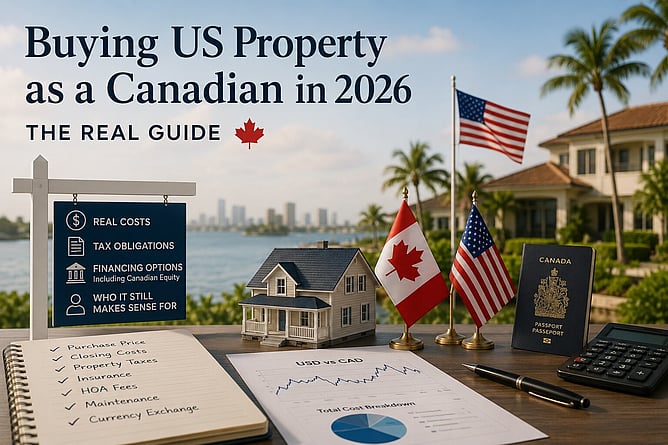
The appeal hasn't gone away. Florida in January. Arizona in February. A place that's yours — warm, quiet, away from the winter. Canadians have been buying US property for decades, and a meaningful number still want to.
But something has shifted. A new RBC survey found that 37% of Canadians say they don't know enough about the cross-border buying process to move forward. Another 27% say the tax implications feel overwhelming, and 29% believe it's simply too complicated or too expensive.
That's not just hesitation. That's a knowledge gap — and knowledge gaps tend to make decisions worse, not better.
This article isn't going to tell you whether to buy US property. That decision depends on factors only you can evaluate: your timeline, your financial position, your retirement plans, your tolerance for complexity. What I can do is give you the complete picture — the real costs, the real process, and the real questions you should be asking before you commit to anything.
The Currency Problem No One Fully Models
The Canadian dollar has been sitting well below the US dollar for years, and the gap matters more than most buyers account for.
At a 0.72 exchange rate, a $500,000 USD property costs you roughly $694,000 CAD before financing, closing costs, or a single year of carrying costs. Every expense denominated in USD — your mortgage payment, property taxes, insurance, HOA fees, maintenance — is subject to that same conversion. A $2,000 USD monthly mortgage payment costs you $2,778 CAD at today's rates. If the loonie weakens to 0.65 — which we've seen before — that same payment becomes $3,077 CAD. That's an extra $3,600 per year without a single rate change.
The part most buyers miss is what happens when they eventually sell. If the Canadian dollar weakens during the years you own the property, your CAD capital gain will be larger than your USD gain — because your sale proceeds convert to more Canadian dollars than your purchase price did. That means you may owe more in Canadian tax than you expect, even if the USD gain looks modest.
Currency risk doesn't disqualify US property as a strategy. But it needs to be modelled honestly, with current numbers, before you decide.
The Tax Layer Most Buyers Discover Too Late
US property ownership as a Canadian involves tax obligations on both sides of the border, and the most common mistake is not understanding them before you buy.
FIRPTA. When a Canadian resident sells US property, the IRS requires 15% of the gross sale price to be withheld at closing — not 15% of the gain, 15% of the total sale price. On a $550,000 sale, that's $82,500 withheld. If your actual capital gains tax comes to $35,000, the remaining $47,500 is recoverable — but only if you file a US tax return and, ideally, apply for a withholding certificate before closing. Most first-time cross-border buyers learn about FIRPTA after the fact.
T1135. If your US property cost more than $100,000 CAD, you're required to file Form T1135 — the Foreign Income Verification Statement — with CRA every year, regardless of whether you earned any rental income from it. This is a compliance obligation, not a tax. The penalty for missing it is $25 per day, up to $2,500, plus potential additional penalties. It's easy to overlook and costly to ignore.
Dual-country rental income. If you rent the property, you file a US federal return (and a state return if applicable) to report and pay US tax on the rental income. You then report the same income on your Canadian return and claim a foreign tax credit for the US tax paid. The Canada–US Tax Treaty prevents double taxation in most cases — but the filings need to happen on both sides.
Section 899. Earlier this year, a provision known as Section 899 was introduced as part of proposed US legislation targeting countries perceived to unfairly tax American businesses — Canada's Digital Services Tax was a named trigger. For a period, it represented a real threat: a retaliatory tax that could have significantly increased the capital gains burden on Canadians holding US property. It was ultimately withdrawn following G7-level negotiations and is not in effect.
That outcome is good news. But the fact that it got as far as it did is worth noting. The US has signalled a willingness to use cross-border tax policy as a lever in trade disputes. That's not a reason to avoid US property — it's a reason to stay informed and make sure your planning accounts for a tax environment that can shift.
The practical takeaway: a cross-border tax accountant is not a nice-to-have. It is a core part of your team. The cost of good tax advice is trivial compared to the cost of getting this wrong.
What It Actually Costs to Own in Florida
Florida remains the most popular destination for Canadian buyers — and for good reasons. No state income tax, no state-level capital gains tax, a large established Canadian community, and a genuine quality of life in the winter months.
But the cost structure has changed significantly.
Insurance. Hurricane and flood insurance in coastal Florida markets can run $3,000 to $15,000 or more per year depending on location, property type, and flood zone designation. Several major insurers have pulled out of the Florida market entirely following major storm seasons, and premiums for the carriers that remain have risen sharply.
HOA fees and special assessments. Following the Surfside condo collapse in 2021, Florida enacted legislation requiring structural inspections and mandatory reserve funds for condo buildings. The practical effect: HOA fees in many buildings have increased substantially, and some owners are facing special assessments in the tens of thousands of dollars to fund structural repairs. A building with $400/month fees today may be a $900/month building with a $30,000 special assessment within a few years.
The carrying cost reality. A conservatively-priced $500,000 USD Florida condo carries annual costs — mortgage, property taxes, insurance, HOA, maintenance, and US tax preparation — in the range of $42,000 to $67,000 USD. At today's exchange rates, that's $58,000 to $93,000 CAD per year. For a property used seasonally, that number needs to be weighed honestly against the benefit.
None of this makes Florida the wrong answer. But the math has to be done with 2026 numbers, not 2015 assumptions.
How Canadians Actually Finance US Property
Most US lenders are difficult to work with as a Canadian buyer. They typically require a US credit score, US income documentation, and an Individual Taxpayer Identification Number (ITIN). For most Canadians without an established US financial footprint, this is a significant barrier.
The practical financing options are three — and the second one is where most people don't realize they already have something to work with.
Option 1: Cross-border mortgage through a Canadian bank.
RBC, TD, and BMO all operate US banking subsidiaries with mortgage programs built specifically for Canadian buyers. They accept Canadian tax documents — T4s, T1 Generals, Notices of Assessment — and qualify you using your Canadian credit history. You don't need a US credit score to get started.
Down payment requirements are typically 20–25% for a vacation property and 25% for a pure investment purchase. One structural advantage worth noting: while Canadian mortgage terms max out at five years, a US mortgage can be fixed for 15 or 30 years. For a long-term retirement property, that rate certainty is genuinely meaningful — and almost no one talks about it.
RBC Bank — available in all 50 states, no lender fees on cross-border mortgages. rbcbank.com/cross-border/us-mortgages
TD Bank — strong presence on the East Coast and Florida. td.com/ca/en/personal-banking/solutions/cross-border-banking
BMO — expanded Western US coverage, private wealth team available. bmo.com/en-us/main/personal/mortgages/cross-border-mortgage
Option 2: Access equity from your Canadian home — without selling it.
If you own property in Canada and have built up equity, you may not need a US mortgage at all. A refinance, HELOC, or second mortgage on your Canadian property can unlock that equity in cash — which you then convert to USD and use to purchase the US property outright.
The mechanics are straightforward. A refinance restructures your existing mortgage and pulls equity out at closing. A HELOC gives you a revolving line of credit secured against your home, capped at 65% of its appraised value. A second mortgage sits behind your first and can access equity in some situations beyond what a HELOC allows. You're borrowing against the value of what you own — not selling, not starting over.
The result on the US side: you show up as a cash buyer. No US lender, no cross-border mortgage application, no ITIN required for financing. A cash offer in the US market is also a stronger negotiating position.
The trade-offs are worth understanding clearly. Your Canadian home becomes the underlying security. A HELOC carries a variable rate that moves with the Bank of Canada policy rate. And you're still exposed to currency risk — borrowing in CAD and spending in USD means exchange rate movement affects your effective cost of purchase.
This is a strategy worth exploring if you have meaningful equity and want to keep the US transaction clean. It's also where a Canadian mortgage advisor adds direct value — structuring the Canadian side properly is what makes the US side simple.
Option 3: US lender directly.
Possible, but harder. You'll need an ITIN, and some lenders add a foreign national premium to the rate. This path is more realistic for buyers who already have an established US banking relationship or prior US credit history. If you're starting from scratch as a Canadian, options one or two are almost always the better starting point.
A note on currency conversion. Regardless of which financing path you choose, never use your bank for large currency conversions. Specialized FX services — Knightsbridge FX, OFX, Wise — charge roughly 0.5% versus a bank's 2.5%+ spread. On a $200,000 CAD conversion, that's a $4,000 difference. It takes five minutes to set up an account.
Who Is Still Buying — and Why the Case Still Holds for Some
Despite the headwinds, 11% of Canadians are either looking to buy or already own US property, according to the RBC survey. Among that group, the motivations are not speculative — 35% cite quality of life and 28% point to retirement or long-term planning.
These are deliberate buyers. They are not ignoring the currency situation, the tax complexity, or the rising carrying costs. They have modelled it, planned around it, and concluded that the benefits still outweigh the friction.
The profile of a buyer for whom US property still makes strategic sense in 2026 tends to share a few characteristics: they are approaching or in retirement with a clear seasonal use case; they hold significant Canadian equity that can fund the purchase without over-leveraging; they have — or are willing to build — the right cross-border professional team; and they are thinking in decades, not years.
Canadians who purchased US properties in the years following the 2008 financial crisis — when prices were depressed and the Canadian dollar was near parity — have in many cases seen exceptional returns. The lesson isn't that US property always works. The lesson is that strategic buyers with a long horizon and proper planning can do very well. The conditions are different in 2026, but the underlying logic holds for the right buyer.
The Team You Need Before You Buy
Cross-border real estate is not inherently complicated. It becomes complicated — and expensive — when buyers try to navigate it without the right support.
A Canadian mortgage advisor who understands cross-border financing. Either through a bank's dedicated program or through a broker with established relationships on both sides. The Canadian side of the financing — whether that's a refinance, a HELOC, or a cross-border mortgage application — determines the entire structure of what's possible on the US side.
A cross-border tax accountant qualified across both CRA and IRS requirements. This person advises on ownership structure before you buy, handles annual filings on both sides, and guides the tax mechanics of eventual sale. FIRPTA, T1135, dual-country rental income reporting — this is not general accounting work.
A US real estate attorney. Required in some US states, strongly recommended in all of them. The closing process in the US is different from Canada — it typically happens at a title company, not a lawyer's office — and having legal representation protects your interests throughout.
An FX specialist. Not your bank. A service built for currency conversion, used for every large transfer.
The cost of assembling this team is real. The cost of proceeding without them is greater.
Making a Clear-Eyed Decision
US real estate is not off the table for Canadians. It's not a trap, and it's not a guaranteed win. It's a complex decision that deserves a clear-eyed analysis — one that accounts for currency, taxes, carrying costs, and long-term planning.
The 37% of Canadians who say they don't know enough to move forward aren't wrong to pause. But the right response to uncertainty isn't avoidance — it's getting better information and building the right team before you commit.
If you're thinking about US real estate — for retirement, lifestyle, investment, or just exploring whether the idea still holds — I can help with the financing side directly. That includes whether your existing Canadian equity is structured in a way that gives you options, and how to think through the Canadian side of the transaction before you ever make an offer south of the border.
Book a clarity call or reach me directly at 289-200-5656.